
Introduction: When Glass Breaks the Rules of Shape
For much of architectural history, glass was flat. It filled rectangular windows, square partitions, and straight-edged facades. But the evolution of glass manufacturing technology has unlocked an entirely new design vocabulary: bent and curved glass. Today, sweeping glass walls, curved shopfronts, cylindrical lift enclosures, and flowing glass canopies are redefining the boundaries of what buildings and interiors can look like.
Krishna Tuff is one of the few glass processors in Gujarat with the capability to manufacture bent (curved) glass in-house. In this blog, we explore what bent glass is, how it is made, and the remarkable range of applications it opens up for architects, designers, and developers across India. Best Glass Manufacturer Company in Gujarat
What Is Bent Glass?
Bent glass, also referred to as curved glass or bending glass, is produced by heating flat annealed glass to its softening point and then carefully shaping it over a mould to achieve the desired curve or radius. Once the glass has taken the form of the mould, it is slowly cooled in a controlled manner.
The result is a sheet of glass with a smooth, continuous curve — free from distortion — that retains all the optical clarity and structural properties of flat glass. The process requires precision temperature control and expert handling to achieve consistent results, which is why bent glass is only available from specialist manufacturers.
Bent Glass vs. Toughened Curved Glass
It is important to distinguish between bent annealed glass and bent toughened glass. For applications where safety is a concern — such as shopfronts, balustrades, or public-facing installations — the glass must be toughened after bending. Krishna Tuff’s manufacturing facility is equipped to perform both the bending and toughening processes, allowing us to produce bent toughened glass that meets both safety and design requirements.
How Is Bent Glass Made?
Step 1 — Mould Preparation
A custom mould is fabricated to the precise radius specified by the architect or designer. The accuracy of the mould determines the accuracy of the final glass curve, so this step demands exceptional precision.
Step 2 — Heating and Shaping
The flat glass sheet is placed on the mould and introduced into a kiln where temperatures are carefully raised to the softening point of glass — typically around 600°C to 650°C. Under gravity or applied pressure, the glass gradually takes the shape of the mould.
Step 3 — Controlled Cooling (Annealing)
The shaped glass is slowly cooled according to a precise annealing schedule. Rapid or uneven cooling would introduce internal stresses that could cause spontaneous breakage. Controlled cooling ensures the glass is stress-free and dimensionally stable.
Step 4 — Optional Toughening or Lamination
If the application requires safety glass, the bent panel can be further processed. Toughening after bending is a technically demanding process that only manufacturers with specialised curved toughening capability can offer.
Applications of Bent Glass in Architecture and Interior Design
1. Curved Glass Facades and Curtain Walls
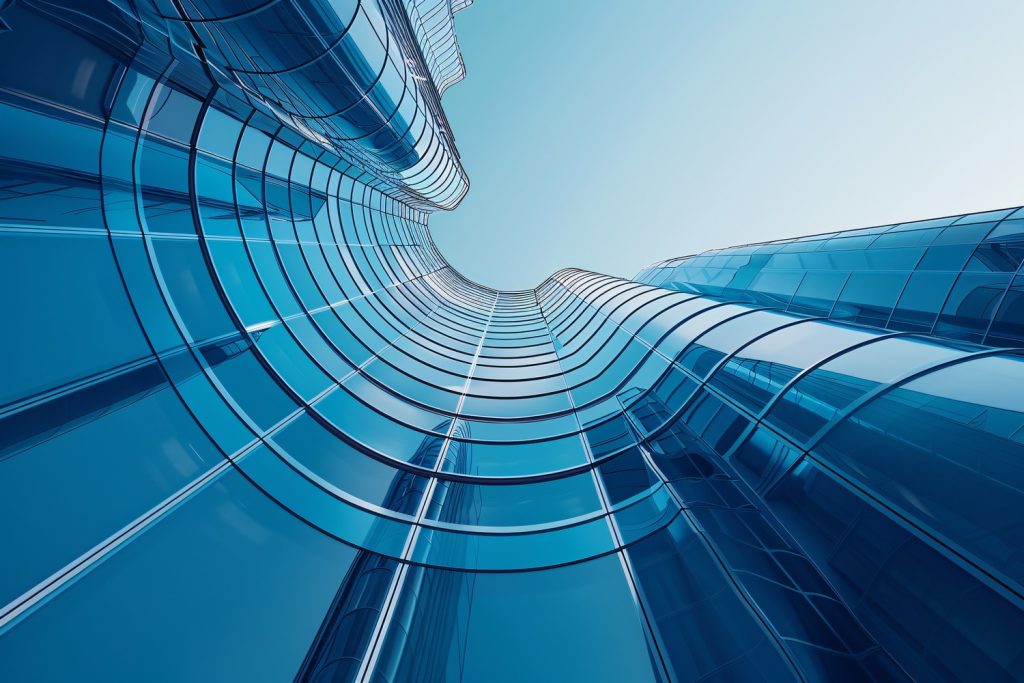
Modern commercial buildings increasingly feature curved or rounded forms that are simply impossible to achieve with flat glass alone. Bent glass panels allow architects to wrap a building in a continuous glazed skin that follows any curved geometry — from gentle arcs to tight radii. This is increasingly popular in corporate headquarters, airports, and landmark mixed-use developments across India.
2. Cylindrical Lift Enclosures
Glass lifts have become a sought-after feature in hotels, shopping malls, and premium office buildings. The cylindrical or semi-cylindrical glass enclosure that surrounds a panoramic lift requires precision curved glass panels at consistent radii. Krishna Tuff supplies bent glass for lift shafts and enclosures across India.
3. Curved Shopfronts and Retail Glazing
Retail brands invest heavily in the visual impact of their shopfronts. A curved glass entrance draws the eye, creates a welcoming flow into the space, and sets a premium brand tone from the moment a customer arrives. Bent toughened glass is the standard specification for curved commercial shopfronts.
4. Curved Glass Partitions and Interior Screens
Inside hospitality spaces, high-end residences, and corporate lobbies, curved glass partitions create flowing spatial divisions that feel organic and architecturally refined. Paired with frameless fittings, a curved glass screen becomes a striking piece of interior architecture in its own right.
5. Glass Canopies and Entrance Structures
Curved glass canopies over building entrances provide weather protection while making a bold architectural statement. The flowing form of a bent glass canopy communicates dynamism, modernity, and attention to design detail — qualities that resonate strongly with premium commercial and hospitality projects.
6. Furniture and Decorative Applications
Beyond architecture, bent glass finds its way into high-end furniture — curved glass tabletops, display cases, cabinet doors, and decorative screens. In retail and hospitality interiors, these elements add a layer of craftsmanship and exclusivity that distinguishes the space.
Why Bent Glass Is a Specialist Product
Not every glass manufacturer can produce bent glass. The process requires a kiln with precise temperature management, custom mould fabrication capability, and the technical expertise to manage the annealing schedule correctly. Poor execution results in optical distortion, uneven curves, or residual stress that can lead to breakage.
Krishna Tuff’s experienced team has developed the in-house competency to produce bent glass to tight tolerances, making us one of the preferred suppliers of curved glass for architects and builders throughout Gujarat and beyond.
Specifying Bent Glass for Your Project
When specifying bent glass, the following parameters need to be defined:
- Radius of curvature (how tight or gentle the curve is)
- Glass thickness and type (clear, tinted, reflective, or extra clear)
- Whether toughening or lamination is required
- Whether the glass is a single curve or compound curve
- Dimensions and edge finishing requirements
Our engineering team works directly with architects and project managers to translate design intent into precise glass specifications, ensuring every curved panel fits perfectly on site.
Conclusion: Bring Your Most Ambitious Designs to Life
Bent and curved glass has moved from a niche architectural feature to an increasingly accessible design tool, opening up possibilities that were once reserved for the most extravagant projects. From sweeping commercial facades to elegant curved partitions and cylindrical lifts, bent glass allows you to push the boundaries of form in ways that flat glass simply cannot.
With Krishna Tuff’s bent glass manufacturing capability in Gujarat, your most ambitious design ideas are well within reach. Contact our team today to discuss your project, share your drawings, and let us show you what is possible.
Comments are closed.

Recent Comments